Here are the photos but I was having trouble with the GoPro and only caught three liftoff videos:
I was the first flight of the day for the first time with the CTI 260H194 Red Lightnin', helped Darrel with his perfect CTI 2771L990 Blue Streak flight, and socialized a bit. The FAA just bumped our waiver from 10k to 15k so I need to get on that! The only hitch is that we need to launch from the corner of the runway so that's quite a trek. I could hear Paul Snow doing the remote countdown over the PA at the launch site and also on Darrel's phone about 1.5 seconds earlier. We didn't specify which was the fire countdown so I was late on the button in the photos. Also, when we got out there, my GoPro would not power on so I missed Darrel's epic liftoff. Duh.
Sunday, December 6, 2015


Saturday, November 14, 2015
Wow I'm a shiftless varmint
My maternal grandfather, Hank, used to call people of questionable drive "shiftless varmints" [vemin] and that's how I would classify myself in the last several months in the rocketry context.
I last flew at Lucerne in June and at Holtville in October. I sort of took the summer off from flying because we're making the planet nearly unbearably hot. Yes its true. We are changing our planet's climate. We should reject the disinformation created by the fossil fuel oligarchy and disseminated by corporate shills beholden to them in our government. But I digress... I couldn't make the November Holtville launch because of an amazing cause. I was planning to attend Lucerne today as it's no doubt amazing up there but I wasn't sure what to fly as of yesterday. As such I started designing and 3D-printing electronics bay caps for what remains of the Viciously Mean Machine. After struggling for a few hours trying to make nylon adhere to the printer's bed I reverted to trusty fluorescent green ABS . Here's what I modeled in Modo:
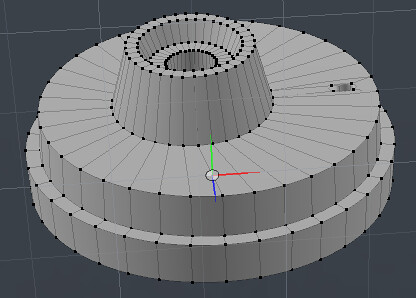
And here's the 3D-print preview in Simplify3D:
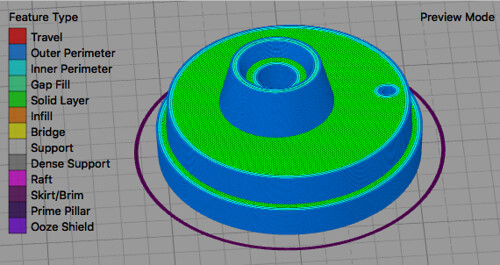
And here are the final prints from my CreatorBot 3D:
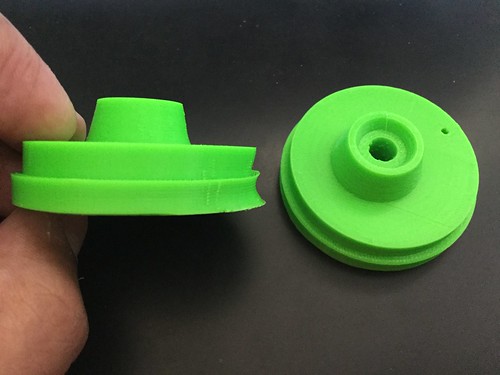
Not quite what I modeled right?! I think a raft would have remedied the edge curvature near the base but the curved edges at higher elevations confuse me. I think it's time to re-level my heated bed and try again. With a little sanding/drilling those caps probably would have worked with an AT 1417K185 today but, by the time I finished the two E-bay caps last night, it was too late to start packing. Now, at 8:47AM, I can't fathom the concept of driving up there through Saturday morning traffic to hurl a couple of sport flights. I will commit to doing more rocket building and repair this weekend and hope to post more updates soon.
I last flew at Lucerne in June and at Holtville in October. I sort of took the summer off from flying because we're making the planet nearly unbearably hot. Yes its true. We are changing our planet's climate. We should reject the disinformation created by the fossil fuel oligarchy and disseminated by corporate shills beholden to them in our government. But I digress... I couldn't make the November Holtville launch because of an amazing cause. I was planning to attend Lucerne today as it's no doubt amazing up there but I wasn't sure what to fly as of yesterday. As such I started designing and 3D-printing electronics bay caps for what remains of the Viciously Mean Machine. After struggling for a few hours trying to make nylon adhere to the printer's bed I reverted to trusty fluorescent green ABS . Here's what I modeled in Modo:
And here's the 3D-print preview in Simplify3D:
And here are the final prints from my CreatorBot 3D:
Not quite what I modeled right?! I think a raft would have remedied the edge curvature near the base but the curved edges at higher elevations confuse me. I think it's time to re-level my heated bed and try again. With a little sanding/drilling those caps probably would have worked with an AT 1417K185 today but, by the time I finished the two E-bay caps last night, it was too late to start packing. Now, at 8:47AM, I can't fathom the concept of driving up there through Saturday morning traffic to hurl a couple of sport flights. I will commit to doing more rocket building and repair this weekend and hope to post more updates soon.
Tuesday, October 6, 2015
Holtville Launch / October / 2015
You'll find this launch was slash-a-rific:
I realized that I don't have a ton to add here except that:
I realized that I don't have a ton to add here except that:
- My pictures of the launch reside here.
- The CTI 1115J530 Imax is a friggin' beast... as are all Pro38 6GXL reloads?!
- I'm a dunce and somehow reduced my delay about 4 seconds too short. The rocket felt so heavy as I was prepping but there was no wind so I'll take responsibility for 2 seconds of that. The other 2 seconds continue to perplex.
- That delay shortage caused a 1.5" zipper in the tube and also flung my AltimeterTwo somewhere in the desert; lost on its maiden flight no less.
Did I mention that it IS rocket science?
Friday, September 11, 2015
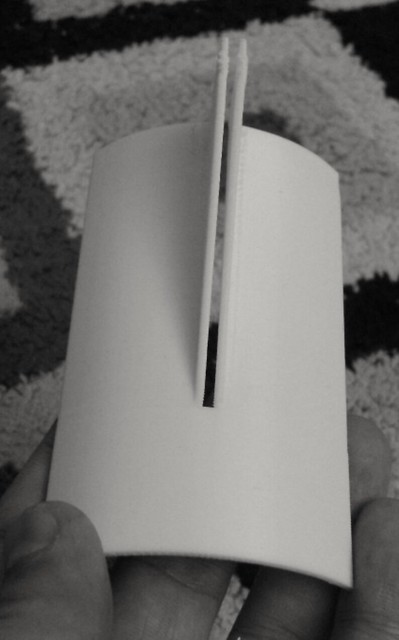
So I had this idea for a Punisher fin alignment jig...
Modeled in Modo, sliced in Simplify3D, printed in white ABS on a CreatorBot 3D:
I'll give 'er a shot tomorrow. And I wish these and their inhabitants hadn't fallen victim to subjective indoctrination:

I'll give 'er a shot tomorrow. And I wish these and their inhabitants hadn't fallen victim to subjective indoctrination:
Saturday, September 5, 2015
And the Punisher replacement commences...
A few updates:
More soon and thanks for pushing my blog to 55k views. Yay, you!
- I missed the July and August Lucerne launches so nothing to see here from there.
- Just last week I realized that I'm unable to attend BALLS this year so that's a bummer. Hopefully in 2016 I will have repaired my Frenzy Massive and travel will come together.
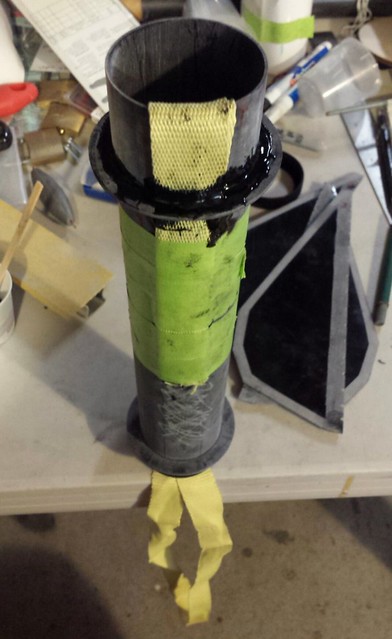
- I did, however, begin rebuilding my Punisher airframe today and here's the motor mount as visual proof:
More soon and thanks for pushing my blog to 55k views. Yay, you!
Sunday, June 14, 2015
RocStock 41: Punisher got punished, M3100s kick ass!
For me it was drag race central at RocStock 41 at Lucerne Dry Lake. David Reese, Mr. Wildman West, organized an amazing deal for a Punisher kit, 2372K1440 White Thunder reload, Pro54/6G casing, and 54mm closure. It was a bit breezy when arrived at ~8:15AM on Saturday morning only to learn that I was supposed to be ready to fly by 8:30AM!! I managed to pull everything together for the Punisher drag race by 8:45 and mine was the sixth rocket on the table for weigh-in/check-in so I wasn't the last. Of the ten planned flyers only nine checked in and the following video summarizes the results (along with the M3100 drag race later in the day):
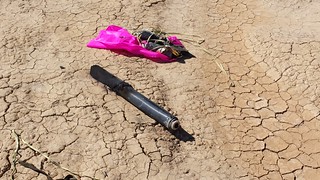
Not that I'm being cross-examined but I certify that I did nothing special to my K1440 reload. I added a bit of SuperLube to the threaded portion of the brand new Pro54/6G casing before inserting the reload, left the delay intact as an apogee backup, and used the stock igniter from CTI. I'm guessing my two counterparts who CATO'd would say the same so one theory was that the propellant might not have cured fully in this batch of reloads. This, in combination with the excessive heat and perhaps humidity, might have played a role in the 33.3% failure rate. Here's a link to an amazing liftoff shot from "Apex Horizon" on Flickr and mine is the center CATO (thanks to Mark Treseder for forwarding but this photographer has sharing turned off so I can't show it inline with my blog). The nosecone, electronics bay, and most of the recovery harnesses survived but here's what's left of my booster (I piled the other parts together atop the parachute):
Here are the Raven3's graph and tabular data from the brief flight. Note that the accelerometer maxed out at 315 Gees so I'll need to check with Featherweight Altimeters on that before flying it again. In the image above one fin is stuck in the ground and the other two presumably blew out as I assume the casing wall failed and overpressure the booster. This fiery activity also likely ignited the 2g bag of black powder and popped the three shear pins securing the electronics bay/nosecone thus saving those costly components. The Raven 3/250G also seems to have popped the nosecone after apogee, such as it was, thus releasing the parachute and further reducing impact damage. The booster was still smoking and, when I picked it up, flames arose. I then buried it in the lakebed clay for a minute or so and the flames extinguished. I returned the booster to David for failure analysis, unscrewed and kept the otherwise intact enclosure, and David immediately replaced the casing and reload. I'm hoping that a few months of extra curing time along with a plan to fly in cooler conditions will render this second K1440 viable. I plan to buy parts for another Punisher booster as this strikes me as a phenomenally volumetrically efficient design.
I was a bit shaken at this point but David verified he still wanted to fly our planned DarkStar Extreme/6118M3100 White Thunder drag race if I did. Since I'd already bonded the grains into the liner I really didn't want to leave that loaded up in my closet and decided to proceed as planned. As always it took awhile to disassemble the CD3 system used in the Punisher and rewire it, along with my second CD3, into the trusty DarkStar Extreme but I was ready at about 1PM(?). Kurt Gugisberg was our RSO and chortled as David and I approached. I asked what he wanted to know about this juggernaut of a rocket and he replied "Ummm... what color is your parachute?" and, while I answered factually, I later suspected he was referring to the business book of the same title. :) David and I set up on pads 41 and 42 and I'm very pleased that we both took off like bats out of hell and recovered our rockets safely. David noted that he heard applause after the race and both of us could clearly see our rockets from apogee all the way down. Here are the GPS plots from Google Earth as well as a recovery shot showing my landing less than 1/3rd of a mile away -- a rarity for any flight of mine:
Here are the M3100 altitude summaries:
Not that I'm being cross-examined but I certify that I did nothing special to my K1440 reload. I added a bit of SuperLube to the threaded portion of the brand new Pro54/6G casing before inserting the reload, left the delay intact as an apogee backup, and used the stock igniter from CTI. I'm guessing my two counterparts who CATO'd would say the same so one theory was that the propellant might not have cured fully in this batch of reloads. This, in combination with the excessive heat and perhaps humidity, might have played a role in the 33.3% failure rate. Here's a link to an amazing liftoff shot from "Apex Horizon" on Flickr and mine is the center CATO (thanks to Mark Treseder for forwarding but this photographer has sharing turned off so I can't show it inline with my blog). The nosecone, electronics bay, and most of the recovery harnesses survived but here's what's left of my booster (I piled the other parts together atop the parachute):
Here are the Raven3's graph and tabular data from the brief flight. Note that the accelerometer maxed out at 315 Gees so I'll need to check with Featherweight Altimeters on that before flying it again. In the image above one fin is stuck in the ground and the other two presumably blew out as I assume the casing wall failed and overpressure the booster. This fiery activity also likely ignited the 2g bag of black powder and popped the three shear pins securing the electronics bay/nosecone thus saving those costly components. The Raven 3/250G also seems to have popped the nosecone after apogee, such as it was, thus releasing the parachute and further reducing impact damage. The booster was still smoking and, when I picked it up, flames arose. I then buried it in the lakebed clay for a minute or so and the flames extinguished. I returned the booster to David for failure analysis, unscrewed and kept the otherwise intact enclosure, and David immediately replaced the casing and reload. I'm hoping that a few months of extra curing time along with a plan to fly in cooler conditions will render this second K1440 viable. I plan to buy parts for another Punisher booster as this strikes me as a phenomenally volumetrically efficient design.
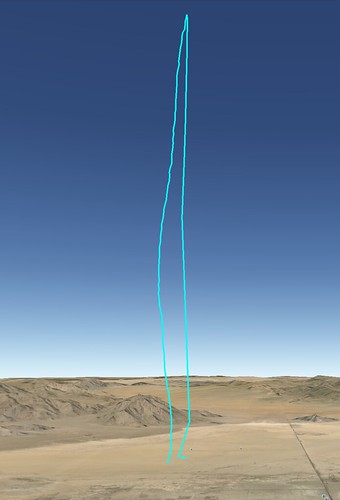
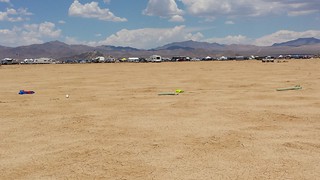
I was a bit shaken at this point but David verified he still wanted to fly our planned DarkStar Extreme/6118M3100 White Thunder drag race if I did. Since I'd already bonded the grains into the liner I really didn't want to leave that loaded up in my closet and decided to proceed as planned. As always it took awhile to disassemble the CD3 system used in the Punisher and rewire it, along with my second CD3, into the trusty DarkStar Extreme but I was ready at about 1PM(?). Kurt Gugisberg was our RSO and chortled as David and I approached. I asked what he wanted to know about this juggernaut of a rocket and he replied "Ummm... what color is your parachute?" and, while I answered factually, I later suspected he was referring to the business book of the same title. :) David and I set up on pads 41 and 42 and I'm very pleased that we both took off like bats out of hell and recovered our rockets safely. David noted that he heard applause after the race and both of us could clearly see our rockets from apogee all the way down. Here are the GPS plots from Google Earth as well as a recovery shot showing my landing less than 1/3rd of a mile away -- a rarity for any flight of mine:
Here are the M3100 altitude summaries:
- Beeline GPS: 15,462' (.kml file)
- ARTS2 baro = 14,999' (table, graph)
- Raven2 baro = 14,805' (table, graph)
- Average = 15,088'
Velocity / axial acceleration peaks:
- Raven2: 1121 MPH / 54 Gees
- ARTS2: 1195 MPH / 38 Gees
And here are the Motor Performance (6451M3506) and Coefficient of Drag plots from the ARTS2. Thanks to all my fellow drag racers and I look forward to future challenges!
Friday, June 12, 2015
Dude built a Punisher!
BAM!! Finish ya after the K1440 drag race tomorrow?
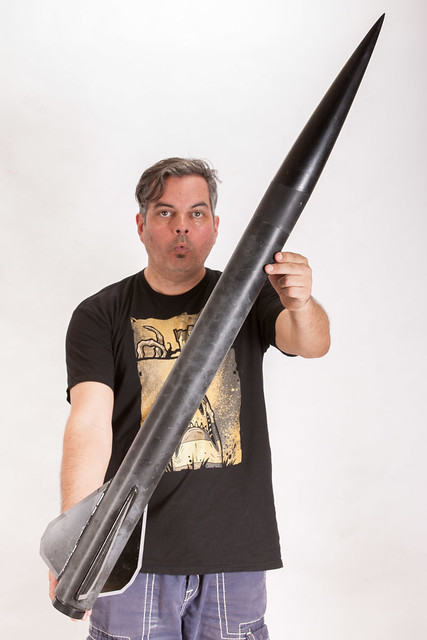
And here's a very aggressive 12g CO2 test for the nose cone:
And here's a very aggressive 12g CO2 test for the nose cone:
Saturday, May 16, 2015
Throwback to c.1981
I recently dug up and scanned a bunch of old photos for my friend's birthday and came across a few of possible interest to the rocketry community:
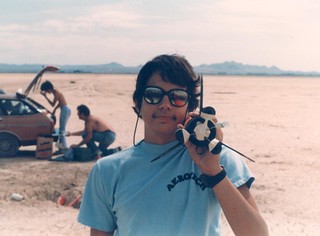
That's me at roughly 12 or 13 years old proudly sporting tethered, fold-up Vuarnet sunglasses; one of two pairs my grandmother had generously purchased for me on her vacation in France. Note also the custom-built Aerotech fanboy shirt with velvet, iron-on lettering. On the back I had made an attempt to run a popular slogan of the time: "Aerotech Gets High On NH4CLO4" and yes that's a capital L. Gary Rosenfield expressed confusion when he first saw my shirt and, in short order, having mentally inventoried the periodic table of the elements, was unable to recall this "L"ement. He was kind about it but, as a chemical engineer now, just know that I'm cringing and yes it should have read NH4ClO4. Duh.
I think that rocket was about 2.5" in diameter and ~5' tall and I called it Gaudior having recently read Madeleine L'Engle's A Swiftly Tilting Planet. I was having trouble with the motor mount diameters just now until The Google turned up this Canadian Crown Rocket Technologies (CRT) catalog [and check out the cornucopia of other retro gems on his site!]. The central motor was a 29mm F67 and the three outboard pods with individual nosecones held CRT 24mm E45 motors (with ejection charges removed). At the time the ignition method du jour for clusters involved sleeved Thermalite Fuse rigs with flashbulb initiators hence the disconcerting business end. Despite a slightly angled liftoff I was convinced the flight had gone as planned. Upon recovery, however, I observed that two of the E45s had CATO'd just after liftoff so I was a semi-sad kid that day and I don't think I rebuilt Gaudior. Damned bleeding edge rocket science! :) Oh and I used to paint all my rockets so I've only become lazy on finishing in the last decade or so.
Next up is Jim Jaworski prepping with a group of early high-power flyers in deep conversation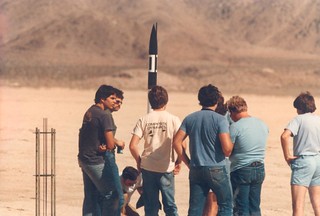
I'm at far left, Gary Rosenfield can be seen just behind me, Jim Jaworski is on the ground setting up his igniter, Jerry Irvine has his back to the camera, and I don't remember the other four fellas on the right. Despite Jerry's infamy in recent decades I always found him to be an extremely intelligent and thoughtful rocketry mentor and a good friend.
Now onto the flight... Jim Jaworski was in/famous for his beautifully built and finished rockets that pushed the total impulse boundaries beyond most of the group but, unfortunately, they often failed in some new way. I'm quite certain this was a J- or K-class ~2" motor with low initial thrust typical of case-bonded, progressive burn geometries of the day. Upon ignition the motor mega-chuffed the rocket off the rod then it laid horizontally on the ground awaiting additional chuffs and eventual ignition. Upon final pressure-up it then shot out horizontally across the desert in spectacularly undesirable fashion. Nobody was hurt and Jim recovered the rubble. We've come a long way with BATES grains and peak thrusts in the beginning with nice regressive traces that don't shred rockets. Someone must suffer these learning setbacks to advance our collective knowledge so... thanks, Jim!
I should note that Aerotech was already employing an early BATES grain precursor where they cast propellant into a cardboard tube. Once core-drilled this "cartridge" of propellant was dropped into the phenolic liner with glass-phenolic nozzle and the forward end sealed up with delay and ejection charge. As such AT motors were bleeding edge and featured end- as well as core-burning geometry. This gave them a nice initial kick off the pad but the high aspect ratio of the cartridge produced a humped thrust trace that wasn't quite the ideal regressive burn yet. Anyway kudos to Gary!
That's me at roughly 12 or 13 years old proudly sporting tethered, fold-up Vuarnet sunglasses; one of two pairs my grandmother had generously purchased for me on her vacation in France. Note also the custom-built Aerotech fanboy shirt with velvet, iron-on lettering. On the back I had made an attempt to run a popular slogan of the time: "Aerotech Gets High On NH4CLO4" and yes that's a capital L. Gary Rosenfield expressed confusion when he first saw my shirt and, in short order, having mentally inventoried the periodic table of the elements, was unable to recall this "L"ement. He was kind about it but, as a chemical engineer now, just know that I'm cringing and yes it should have read NH4ClO4. Duh.
I think that rocket was about 2.5" in diameter and ~5' tall and I called it Gaudior having recently read Madeleine L'Engle's A Swiftly Tilting Planet. I was having trouble with the motor mount diameters just now until The Google turned up this Canadian Crown Rocket Technologies (CRT) catalog [and check out the cornucopia of other retro gems on his site!]. The central motor was a 29mm F67 and the three outboard pods with individual nosecones held CRT 24mm E45 motors (with ejection charges removed). At the time the ignition method du jour for clusters involved sleeved Thermalite Fuse rigs with flashbulb initiators hence the disconcerting business end. Despite a slightly angled liftoff I was convinced the flight had gone as planned. Upon recovery, however, I observed that two of the E45s had CATO'd just after liftoff so I was a semi-sad kid that day and I don't think I rebuilt Gaudior. Damned bleeding edge rocket science! :) Oh and I used to paint all my rockets so I've only become lazy on finishing in the last decade or so.
Next up is Jim Jaworski prepping with a group of early high-power flyers in deep conversation
I'm at far left, Gary Rosenfield can be seen just behind me, Jim Jaworski is on the ground setting up his igniter, Jerry Irvine has his back to the camera, and I don't remember the other four fellas on the right. Despite Jerry's infamy in recent decades I always found him to be an extremely intelligent and thoughtful rocketry mentor and a good friend.
Now onto the flight... Jim Jaworski was in/famous for his beautifully built and finished rockets that pushed the total impulse boundaries beyond most of the group but, unfortunately, they often failed in some new way. I'm quite certain this was a J- or K-class ~2" motor with low initial thrust typical of case-bonded, progressive burn geometries of the day. Upon ignition the motor mega-chuffed the rocket off the rod then it laid horizontally on the ground awaiting additional chuffs and eventual ignition. Upon final pressure-up it then shot out horizontally across the desert in spectacularly undesirable fashion. Nobody was hurt and Jim recovered the rubble. We've come a long way with BATES grains and peak thrusts in the beginning with nice regressive traces that don't shred rockets. Someone must suffer these learning setbacks to advance our collective knowledge so... thanks, Jim!
I should note that Aerotech was already employing an early BATES grain precursor where they cast propellant into a cardboard tube. Once core-drilled this "cartridge" of propellant was dropped into the phenolic liner with glass-phenolic nozzle and the forward end sealed up with delay and ejection charge. As such AT motors were bleeding edge and featured end- as well as core-burning geometry. This gave them a nice initial kick off the pad but the high aspect ratio of the cartridge produced a humped thrust trace that wasn't quite the ideal regressive burn yet. Anyway kudos to Gary!
Sunday, May 3, 2015
Sunday build-day
I'm sad to report that I missed the Holtville launch yesterday but I got a second wind today, cleaned my garage workspace a bit, and did some building today.
David Reese of Wildman West Rocketry is hosting a Punisher drag race at Rocstock 41 in June at Lucerne. He offered up a limited edition Punisher kit bundle along with a Pro54 5G casing, closure, and K1440 White Thunder reload and I lucked into buying one before they stocked out. I know that David and Kurt Gugisberg are in on the drag race so I'm looking forward to losing to them. :) Here is Crazy Jim's version and he has has also posted a useful build thread on The Rocketry Forum:
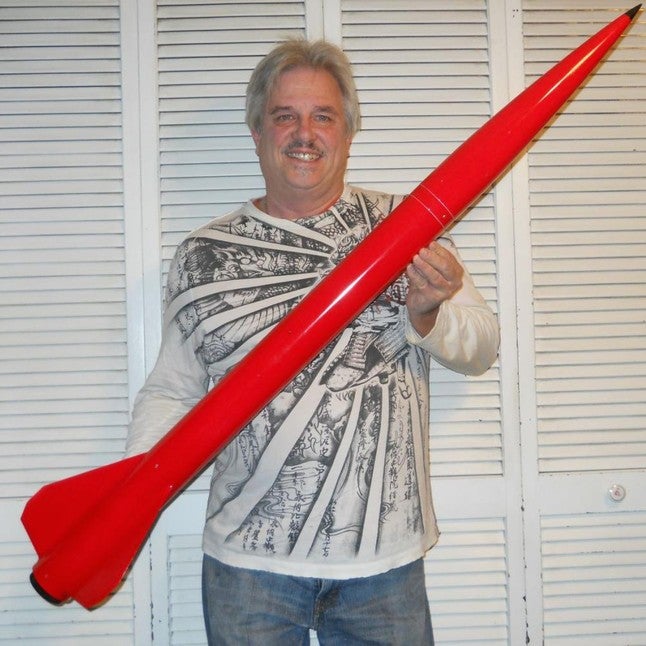 So I started building my 3" Punisher today and a whole bunch o' sanding prep was required for the motor mount, motor retainer, and centering rings but here's the assembly now curing in my garage:
This kit features a novel dual deploy scheme where the electronics bay resides in the nosecone shoulder and that coupler is shear pinned into the airframe and nosecone. It's a solid design and uses volume very efficiently. It's therefore atypically small and that 2372K1440 is going to kick it's ass into the sky with reckless abandon. K1440 don't care. K1440 just brutalizes what it wants.
I also continued the build of my Polecat Aerospace 7.5" V2 with 75mm motor mount. This this second build step anchors the motor tube with centering ring in the boat tail (one large centering ring and the airframe tube are used temporarily to center the motor tube in the boat tail while the epoxy cures below the fin slots):
David Reese of Wildman West Rocketry is hosting a Punisher drag race at Rocstock 41 in June at Lucerne. He offered up a limited edition Punisher kit bundle along with a Pro54 5G casing, closure, and K1440 White Thunder reload and I lucked into buying one before they stocked out. I know that David and Kurt Gugisberg are in on the drag race so I'm looking forward to losing to them. :) Here is Crazy Jim's version and he has has also posted a useful build thread on The Rocketry Forum:
This kit features a novel dual deploy scheme where the electronics bay resides in the nosecone shoulder and that coupler is shear pinned into the airframe and nosecone. It's a solid design and uses volume very efficiently. It's therefore atypically small and that 2372K1440 is going to kick it's ass into the sky with reckless abandon. K1440 don't care. K1440 just brutalizes what it wants.
I also continued the build of my Polecat Aerospace 7.5" V2 with 75mm motor mount. This this second build step anchors the motor tube with centering ring in the boat tail (one large centering ring and the airframe tube are used temporarily to center the motor tube in the boat tail while the epoxy cures below the fin slots):
April Lucerne launch report - Go, K300, go!
I flew my first CTI 2546K300 at Lucerne last month and I'm a big fan.
I busted out my robust but rarely flown Vertical Assault from Giant Leap Rocketry and the flight sim'd to 14,000' AGL. While I left my DSLR at home and my onboard keychain camera failed inexplicably just after starting it I did get some solid Beeline GPS data for Plotting in Google Earth:
I'm hoping that David Reese might have grabbed a liftoff photo that I can cross-post to this blog. :) [Update: David is my hero!]
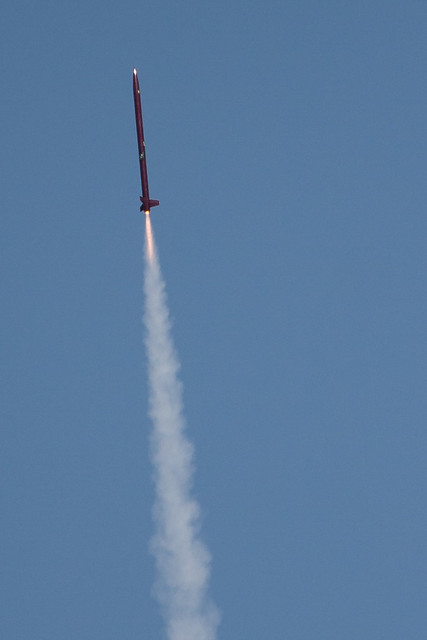
The liftoff was relatively quick but the rocket exhibited coning at about 1000'. This makes sense since the Vertical Assault is overstable, even with a Pro54 6GXL motor, and was at a 2.8 static margin at liftoff. After the coning ceased the flight quickly sprinted out of site so I'm grateful I had GPS running. It's been awhile and I managed to forget that GPS reports via APRS to my radio report MSL (Mean Sea Level) numbers so I was a bit befuddled when the altitude reports stabilized at 3,079' high and 1.3 miles due north. In following the heading North I eventually saw an orange parachute briefly blow up above the heat convection ocean as if the rocket were saying "Howdy! I'm here!" Yet another 1+ mile jaunt found the rocket in solid condition:
There were some scrapes on the maroon-ish car paint but I'll wipe most of those off. The Raven2 (tabular, graph) reported maxima of 13,814' AGL, 799 MPH, and 38 Gees (that acceleration seems way too high). The GPS maxed out at 14,160' AGL so the average was 13,987' and that's pretty damned close to RockSim/OpenRocket's simulations! Since the Vertical Assault is mostly set up I think I'll fly a CTI 2772L640 Dual Thrust at Lucerne in May. Yay.
I busted out my robust but rarely flown Vertical Assault from Giant Leap Rocketry and the flight sim'd to 14,000' AGL. While I left my DSLR at home and my onboard keychain camera failed inexplicably just after starting it I did get some solid Beeline GPS data for Plotting in Google Earth:
I'm hoping that David Reese might have grabbed a liftoff photo that I can cross-post to this blog. :) [Update: David is my hero!]
The liftoff was relatively quick but the rocket exhibited coning at about 1000'. This makes sense since the Vertical Assault is overstable, even with a Pro54 6GXL motor, and was at a 2.8 static margin at liftoff. After the coning ceased the flight quickly sprinted out of site so I'm grateful I had GPS running. It's been awhile and I managed to forget that GPS reports via APRS to my radio report MSL (Mean Sea Level) numbers so I was a bit befuddled when the altitude reports stabilized at 3,079' high and 1.3 miles due north. In following the heading North I eventually saw an orange parachute briefly blow up above the heat convection ocean as if the rocket were saying "Howdy! I'm here!" Yet another 1+ mile jaunt found the rocket in solid condition:
There were some scrapes on the maroon-ish car paint but I'll wipe most of those off. The Raven2 (tabular, graph) reported maxima of 13,814' AGL, 799 MPH, and 38 Gees (that acceleration seems way too high). The GPS maxed out at 14,160' AGL so the average was 13,987' and that's pretty damned close to RockSim/OpenRocket's simulations! Since the Vertical Assault is mostly set up I think I'll fly a CTI 2772L640 Dual Thrust at Lucerne in May. Yay.
Subscribe to:
Posts (Atom)
