Monday, April 3, 2023
Holtville April 1, 2023


Sunday, November 6, 2022
Holtville Havoc 2022


Tuesday, April 5, 2022
Holtville April 2, 2022
Oh hi there. I'm known to blog... occasionally.
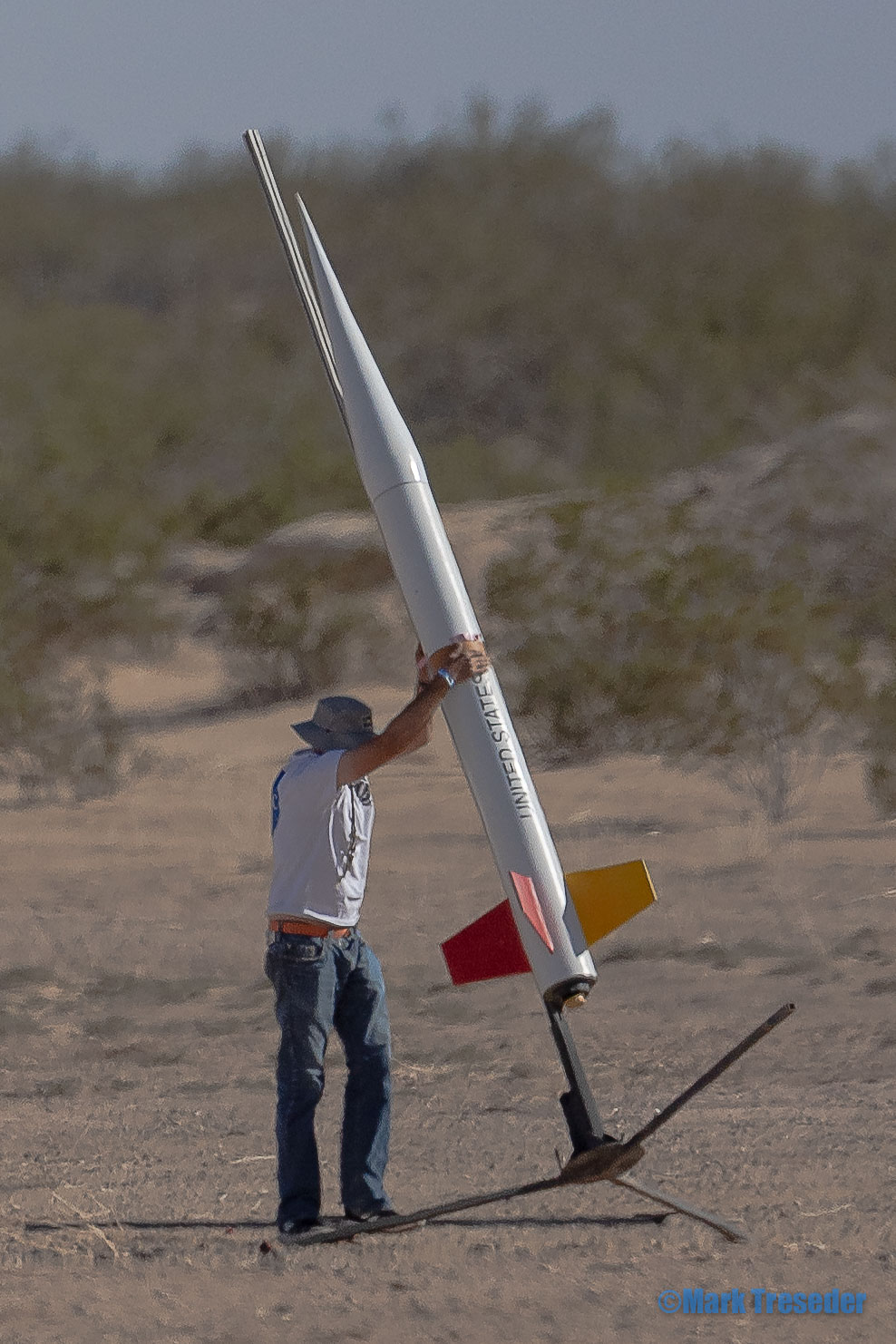
I attended the most recent launch at Holtville, CA and a fine day it was. I flew only a CTI 168H410 Vmax reload in my DarkStar mini. It sorta got up and went as expected. I captured no pixels of this flight except recovery which was close and convenient for once.
The rest of the launch I sought to regain some photographic skills. This new camera astounds but I'm still struggling with focus a bit. Today I shot primarily using manual focus. I'm also using a 1.4x II teleconverter as this 1Dx mark III is full-frame and that robs a bit of reach so the loss of one stop (f/2.8=>f/4.0) seems worth it.
I captured two nifty flights...
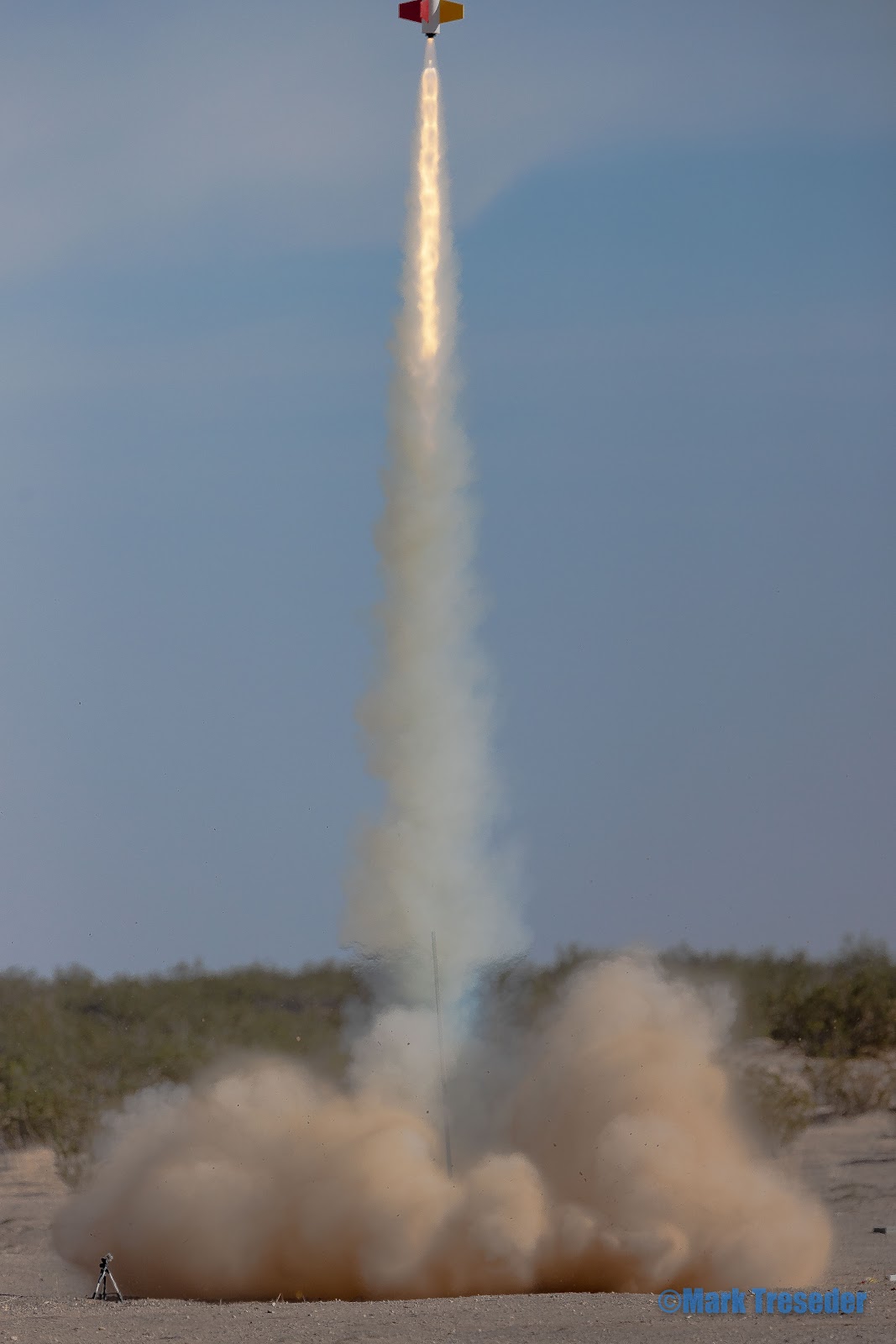
The first was Russ Sands' rocket on an AT 7301M4500 Super Thunder reload. It, too, got up and went quite briskly. Russ was able to fully recover the rocket so a fine flight it was.
The second was Paul Snow's "Intercontinental Transport" and he's authored that very thorough build thread on RocketryForum.com. This was another beautiful flight and the shock cord had conveniently snagged on the airframe providing a gentler horizontal descent.
I'm looking forward to flying more as the season progresses. I also learned that the SD club's planning a second flight of the Trident at LDRS 40 at Lucerne Dry Lake June 9-12 of this year. Be there!
Saturday, June 5, 2021
Holtville June 5, 2021
It's been 15 months since my last launch... but that pandemic pause ended today.
I drove out to Holtville and experienced a rather extreme temperature gradient in moving from coast to the eastern CA desert: 63˚F to 103˚F (108˚F on the way back!). Wow. I was only able to fly one rocket but that felt good indeed. Luckily I've been hitting the gym on alternate days in recent years (except for closures driven by pathogen precautions) and felt quite solid walking in the heat today.
I flew the CTI 1750K650 Pink (Pro54/5G) motor in my Polecat Aerospace [White :) ] Raven. The motor was awesome but I'll need to microadjust focus on my new camera:

- I had packed my pair of Rockontrollers but forgot to charge them. Despite remaining uncharged for 2+ years these units still served to launch my rocket wirelessly. Nice work, Frank! And thanks for pushing those buttons, Paul! And thanks, Daniel, for setting up the 200ft pad!
- My new camera shoots at 16fps. I only captured three frames of the liftoff during its rapid ascent but it might prove interesting to estimate acceleration rates with these [back focused] photos. More soon.
I'm now fully immunized
I got my second Moderna shot roughly one month ago. I can't wait until everyone proudly declares they've been immunized. Yay, medical progress!
Sunday, March 1, 2020
Building resumed...

I still need to seal the exterior and sand it smooth. I've had Aeropoxy Light in my garage for years and only opened it up this morning:

I applied the paste to some test plywood this morning as well as slightly dilute and more dilute (with isopropyl alcohol). I covered 1/2 of these test swaths with plastic film to evaluate that smoothness/uniformity knob. It's curing now and I'll try sanding the test block today. More soon.
Monday, February 10, 2020
Lucerne, 2/8/20


You'll notice that initial tilt straightened right out to vertical. Now let's back up before the launch...
First off I seem to have misplaced my stainless steel seal disc, required for AT Super Thunder 98mm reloads, at home. I have yet to really dig for it but emailed David Reese, fellow TAP and proprietor of Wildman West Rocketry, and he Kindly said he'd loan or sell his spare to me. I purchased his so now there are two such 98mm discs in my home; handy.

I'd performed a bit of prep the night before but, as previously noted, I'm slow. The wind was kicking up from zero to substantial as my prep wrapped up. I was committed to launching, however, so I just kept moving forward. As I neared the LCO table I encountered Kurt Gugisberg; the TAP who'd signed off on my L3. He noted that there wasn't a 1515 rail at the 500' pads but offered to grab one from the club's trailer. He then kindly walked with me out to the pad and helped me load up this 44lb beast.
Earlier this month (Feb) I learned that my GoPro Hero 5 camera shoots 240 fps in 720p at Holtville. I'd never noticed the resolution increase from 480p since I'd apparently never explored the camera's UI. Dum. In any event I was all psyched to shoot this M4500 liftoff at 240fps and was indeed running the camera in this mode while the rocket was on the pad.
Then I headed in to the LCO table, manned by David Reese, only to learn that I'd neglected to connect the installed initiator leads. Dum. I then walked out to the pad pausing the GoPro on the way. I connected the leads and headed back to the table. Note that I hadn't restarted the camera. I realized this but the wind seemed to steadily increase so I opted to skip the slow-mo vid of this launch and instead shot the above still sequence hand-held.
Liftoff was essentially instantaneous and the Mega Cowabunga quickly roared to a lofty altitude. I'd estimate that flame to be roughly 10-11 feet long. Again Epic. I saw the ejection at apogee but then lost site of the rocket under 'chute. Luckily I had a clean Comm-Spec transmitter signal and began walking downwind (East) following that signal. I ended up trekking 2 miles E-NE and found the rocket intact:


I'm estimating the endpoints of the above line drawn in Google Earth but they're pretty close. Kurt noted that the owner of that property where my rocket landed was speculated to have gathered many previous rockets and may have them in a spare room. Noted, Kurt, but mine escaped such a fate this day.
My new Raven4 altimeter seems to have worked flawlessly alongside the Raven3. The average of the two devices is:
Altitude (AGL): 9,668 ft
Speed: 811 MPH (speed of sound is 771MPH @ 73˚F so mach 1.05)
Acceleration: 37.6 gees
Here are screen grabs from the Featherweight Interface Program:
Raven4: (altitude, speed, accel)(tabular)(acceleration only, thrust curve)


Raven3: (altitude, speed, accel)(tabular)(acceleration only, thrust curve)


As I slowly walked the Meg'Cow' back toward my car I noticed that the sustained winds had shut the range down. Kurt then handed me both 1515 rail guides as they'd separated from the rocket under intense acceleration. Oops. I'm grateful the ascent ended up so vertical!
So I remain a big fan of Aerotech Super Thunder propellant. Having now flown their L2500 and M4500 I'd like to fly the M6000; as prompted by David Reese. Look for this flight in the future but I still have to fly the CTI M6400; hopefully at Holtville Havoc in March. Thanks for reading!
Addendum: I forgot to mention that I lost my CD3 (CO2) assembly. It ejected the 'chute then ejected itself from its attachment to the shock cord. If you found a CD3 assembly on Lucerne Dry Lake after the launch please consider returning it. Thank you.
Sunday, February 9, 2020
Holtville 2/1/2020
And here are my still photos.
I've made two intriguing discoveries with my GoPro Hero 5 black: 1) The GoPro app rules and serves as the POV previewer I've craved and 2) Somehow I never checked for updated resolutions when I bought this hero 5. After shooting the above vids I learned that the Hero 5 supports 240 fps shooting in 720p!! So this will be my last vid shot in 480p and scaled to 720p. I also learned that the Hero 8 shoots 240fps in 1080p. So, now that I've discovered 720p/240, perhaps it's time for an upgrade. Enjoy.
Holtville, 1/4/2020
And here are my photos.
I'm quite certain that the first was Val Derkatch's, the second Mark Treseder's, and the third... well I just don't remember. But check those titania sparks, huh?!
Saturday, June 8, 2019
Bailing on NSL
Today I was planning to fly an Aerotech M4500 Super Thunder (98/7680 casing) in the Madcow 8" Mega Cowabunga. That would have been a new thrust maximum for me but, after a lengthy but cool day at work yesterday, I went to bed having forgotten to bond the grains. I also just discovered that my Raven LiPo batteries are bloating and will no longer charge. As such this exciting new thrust maximum will have to wait.
I went to FeatherweightAltimeters.com to order replacement batteries and discovered the Raven4. I bought one also. :)
Thanks for occasionally checking in and I expect to rebuild my rocketry prowess in the coming weeks and months.
