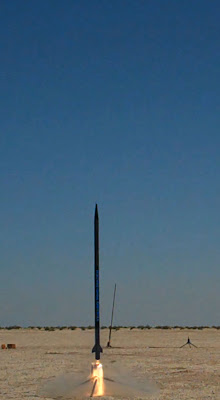
Saturday, August 21, 2010

On the mend

So I've now overcome the sadness of Der Red Mix and embarked on DRM mark II:
  • Last night I think I thoroughly mastered both the Parrot2 and Raven altimeters via manuals, testing, and marking of the terminals. I will not repeat my mistakes of last Saturday.
  • I decided that DRMII will use all BlueTube 2.0 rather than phenolic and just ordered four tubes. This should greatly improve strength overall and will reduce my finishing time demonstrably over mark I.
  • I made some small positional adjustments to the mark II design in RockSim as refinements. I think I'll need less nose weight this time for a typical flight.
  • In mark II I can revert to the original position of the Flip video cam cowling so there should be no fin visible this time.
  • I'm considering cutting my own fins and centering rings this time but might still go with laser cutting at BMS. TBD.
  • I'll combine some of Kurt Gugisberg's painting advice with a new support rig I've devised to minimize dust kickback. Hopefully I can avoid car paint pitting this time. I'll also apply the decals before flying to underscore confidence in my revised approaches.
Cathartically this rebuild is now more important to me than attempting 2000MPH at Plaster Blaster in November. Also I just bought my own Pro75 6G hardware set for that flight but I wanna put some miles on that casing elsewhere first. Oh and KO sent her shot of the DRM fail. It better shows how the Flip camera landed safely:

Wednesday, August 18, 2010

Lucerne, 8/14/10 - Der Red Mix FAIL on maiden flight

Let's start with the onboard video and then I'll explain:
First off can you BELIEVE my Flip MinoHD video camera survived that high-speed impact?! That has to be one of the few surviving onboard video accounts of a high-power rocket crash. Props, Flip!
OK so this was to be the maiden flight of my scratch-built, 7.5", clustered upscale of Estes' Der Red Max but cluster = Mix in my case. While I had access to 7 motor slots I wanted to walk before running so I chose to ground-start a CTI K500 Red Lightning, wait 1 second, then air-start 2 x I345 White Thunder motors. It shoulda kicked ass. However, operator error resulted in a great ground start, no air-starts, and no ejection of the main parachute at apogee. Jenius.
After the flight I downloaded the data from the Parrot2 and Raven altimeters from www.featherweightaltimeters.com. Those little devices never cease to amaze me as they're tiny yet record a large number of data streams at high temporal resolution. Nothing leapt out at me at first so I decided to e-mail the data to Adrian at Featherweight. SERIOUS props to him because, independent of his workload at NASA, he quickly responded that none of my four e-matches had shown continuity. Despite reading both manuals numerous times I'd made the following three mistakes:
  • Raven - responsible for air-start ignition & main parachute ejection - This was my first time using the Raven. While I thought I understood the wiring of this device I had clearly allowed my familiarity with other altimeters to lead me astray. The 9V battery does not connect directly to the altimeter as in most other altimeters. Instead it's grounded in the altimeter but the positive lead is connected to one of each of the e-match leads and optionally through an arming switch. The other leads of the e-matches feed into the relevant output connectors in the terminal block. [Addendum: if not using an arming switch you can also gang the second e-match leads in the + terminal slot. I verified this with a test connection.] Lesson learned: RTFM ad nauseum!

  • Parrot2 - backup altimeter for main parachute ejection - I lost my original Parrot2 (250G) model a few months ago in the J1520 minimum diameter flight. I was able to purchase an unused Parrot2 (70/30G) model from a fella on the forums. In re-reviewing the wiring diagram I mis-marked the power inputs for the 9V pyro battery so the thing was running solely on the LiPo battery the whole time. The apogee e-match never had a chance of igniting. I don't use separate arming switches so this wiring option consistently confuses me. Lesson learned: When in doubt get a second opinion.
  • Finally I left the K500's motor ejection in place as a secondary backup for parachute ejection. I was so confident that one of two altimeters above would do the trick, however, that I didn't shorten the delay from 17 seconds to 14 seconds. Let me tell you that 3 seconds is a LOOOOONG time when a rocket is coming in ballistic! Lesson learned: When possible trim the motor delay to simulated apogee + 1 second.
Here are some other pix:

Oh and KO and I were finally able to run our "Squat redemption" drag race on matching CTI I140 motors:
I edged her 'Cheshire' out by a length but the the motors look slightly different to me. I bought them at the same time so I'm not sure what's up with that. I will say that it appeared to be a tie to me until I downloaded the photos.

Sunday, July 11, 2010

Lucerne launch report, 7/10/10

Yesterday started cloudy but windless on the lakebed. I quickly prepped my newly-stable Squat rocket for the drag race my friend KO and I had planned. She was stuck in traffic so I then prepped and flew my Dark Star Lite with the new CTI H410 Vmax motor. That thing is insanely fast!! The following two shots were taken 1/8th of a second apart at 1/800th of a second shutter speed. Note the excessive motion blur on the second shot:


And I've zoomed in on the very cool glow of the motor ignition here about one millisecond after ignition. Vmax propellant is very efficient and barely visible were it not for the blast plate accumulation:
KO finally overcame the ridiculous I-15N traffic and prepped her Cheshire-style Squat. As I mentioned in my LDRS report below these kits are unstable with 54mm 1-grain motors unless one adds at least 8 oz of weight to the nose tip. KO and I used Crazy Glue's Plastic Fusion epoxy to bond the lead into the polyethylene nosecone. According to their claims this should have worked except that, as I we walked up to the RSO table, I heard a clunk and knew my weight had slipped out of the nose tip. For the second time I can't fly my damned Squat!! KO decided to fly hers on a CTI I140 Skidmark anyway in the hope that her nose weight would stay in place:


Well her flight started straight as you can see but then the weight slipped, the flight went unstable, and the rocket looped about five times before hitting the ground. Luckily she built hers well and it survived the impact with only cosmetic damage. Lesson learned: only the expensive 3M DP 8005 resin will truly stick stuff to polyethylene and polypropylene! You can use regular epoxy but you must use expanding foam to hold that mass in place. Stupid inert polymers!
The wind started kicking up after noon but I prepped my bullet for an AT J340 Metalstorm flight anyway. This motor is Aerotech's first foray into sparky motors and they've elected to back the flaming titanium chunks with white smoke rather than black. They also demo'd their Skidmark equivalent called 'Dark Metal' at LDRS so those'll be cool. One can never incinerate too much loud, impressive elemental titanium in one flight. All of my flights seem to drift well beyond all others independent of wind level. Today, however, this particular flight landed within 100' of the pad and that's some serious luck!:

I also shot a few sequences with the intent of stitching together a virtual drag race in Photoshop. Normall I don't like sooty Blackjack/Smoky Sam motors but the wide-angle perspective of this frame intrigues me so I shared it in isolation here:

Finally Frank Hermes brought his dog River out so I could get my yellow Lab fix. He's a good buddy and I thank him for braving the 100˚F heat!

A brief pause from rocketry...

Megan Fox WIN!

Wednesday, June 16, 2010

LDRS 29: A windy but impressive international launch!

I was able to attend LDRS 29 at Lucerne Dry Lake, CA from Friday@11AM through Sunday@3PM. With rare exception it was windy/gusty the entire time and the only relief came between pronounced wind direction changes. We seriously experienced wind from all directions except perhaps South-East. Despite those damned pressure gradients some amazing flights succeeded with few failures and no shreds that I saw. I'll start with my only flight of the event as I was enjoying watching/chilling most of the time and experience what turned out to be a caffeine withdrawal headache all day Saturday. Here's the 7.5" Nike Smoke I used for my L3 flying on an Aerotech M2400:

The initial angle is strikingly similar to my L3 flight on the M2030 Mojave Green motor back in 2008. So, in summary, I've had two arrow-straight flights (M1297 and M1939) and two seriously angled flights (M2030 and M2400) in this rocket. The first two motors use White Thunder propellant and the second pair are comparatively high thrust so was one of those factors the cause? Then I downloaded/analyzed the ARTS2 data for motor performance:

Wow that's a 2x average thrust spike in beginning of the burn. This points perhaps to erosive burning and almost identically matches the thrust curve shape for my M2030 L3 flight (motor later recalled/modified due to erosive burning issues at higher ambient temperatues):
I count myself lucky that neither flight cato'd but I think that initial kick might explain the less than vertical initial ascent off the rail. Here's the ARTS2 flight summary and graph:

That anomalous spike in the pressure altitude graph would indicate an instantaneous pressure drop. As that seems unlikely I rounded the ARTS2 peak altitude down to about 6703 ft. Here's the AltAcc2C summary and admittedly jacked graph data:

The y-axis range thing must be a BlackSky Flight Analyzer bug in Windoze 7. Dunno but the average of the two barometric altitudes is 6,996 feet or 4 feet under my estimated altitude of 7,000'. Who needs RockSim/OpenRocket?!! [Yeah I can solve differential equations numerically via fourth order Runge-Kutta in my head... what of it?] Dual deploy failed because the heavy nosecone dislodged at apogee. Also the booster did take a bit of damage near the top of the tube not because of a near zipper but because of a draggy impact on the lakebed. I found a phenolic chip on the ground near the tube that had drug into the ground. Bummer. So three of four flights have required repair after flight. Perhaps it's time to switch exclusively to Blue Tube?
During my lengthy observation periods I shot a number of photos, mostly from the comfort of my canopy, and posted them here. Highlights for me included (not in chronological order):
  • Visting/working with Frank Hermes and my friend KO and her niece Christina over that time. Frank's work on gyro-based, upper-stage ignition inhibition system is groundbreaking and he had better be recognized for this innovation soon.
  • It was an unmitigated pleasure meeting Dr. Jeroen Louwers from Cesaroni. That dude is sharp and kind. Also Mark Canepa is super convivial and his photo and writing contributions to Rockets Magazine remain top notch.
  • Watching numerous N and O motor flights including N1000, N2000, O8000 and others. I sincerely hope the CA State Fire Marshall lifts the arbitrary 10,240/20,480 N•s power limit for our state and brings us in line with the other 49. It's only fair, sir!
  • Bowing out of the Squat drag race due to marginal stability with a 1-grain Pro54 motor casing was a good call. I watched no fewer than 7 identically unstable flights with the I140 Skidmark motors everyone had bought for the Squat drag race. Most folks had checked the CP/CG relationship and added nose weight. I was so busy finishing Der Red Mix (which I never flew due to wind) that I thought I would be safe flying the smallest motor that would fit the mount. Nope. I'll modify mine and fly it next launch because those I140 Skids are loud and amazing!
  • The 6 x N10,000 drag race was stellar. I hadn't noticed that Kari Byron of Mythbusters was hosting the Discovery Channel show covering LDRS 29 (to air on July 5th on Discovery Science) until I saw her Sunday before I left. Then I got home, downloaded my photos, and see her posing in front of those ascending beasts!
  • Jack Garabaldi and his buddy Jim Daugherty flew another N10,000 drag race the next day using half-scale Patriots and it was no less amazing. Those motors are insane!
  • One of my favorite flights ever was Tim Lehr and team's 25 ft. tall Mega Dark Star flight on 3 x K2045 motors and one of the new CTI O3700 Skidmarks. Check my photo slideshow excerpted from above for the full sequence but here's a telling frame:
Overall this was an amazing launch and I want to thank everyone in the ROC club for hosting this year. I also want to thank Rob Greenlaw and his daughter Megan for being nice peeps and for driving me and my 50 lb. Nike Smoke back to my camp. That would have been a rough walk! Oh and thanks also, Rob, for the setup and recovery photos:

Monday, June 7, 2010

I ♥ sanding!!

It's my favorite. No really.
After about 90 minutes of dust generation I turned this rough, UV Primed surface into a very smooth one:
I put one final coat of UV Smooth Prime on tonight and the surface is very uniform. I think I filled in all the pinholes so after one more [really fun] sanding sesh tomorrow I can apply the red car paint. I'll let that dry overnight, paint the black on the top of the airframe and nosecone on Wed., let that dry overnight, apply decals on Thursday, and finally overcoat those with clear coat. That should be dried and purdy by the time I head up to LDRS.

Sunday, June 6, 2010

Plaster City @ 108˚F... but it's a dry heat!

Yesterday was the last Plaster City launch before the summer heat break. However heat arrived early as it was 80˚F at 8AM and 108˚F when I left at about 3:30PM!!
My first flight of the day was the Viciously Mean Machine 0.75 with a CTI J1520 Vmax motor (static firing video). I prepped everything and got it out to the pad only to find that the 250G Parrot 2 altimeter would not arm. I pulled it and took it back to my prep area to find that it wouldn't even power on. I swapped 9V batteries but still now power up. Then I hooked the altimeter up to my computer to find that 4 of 5 memory banks held data. I knew that I'd purged all flights the night before so this was confusing. I then figured out that the Parrot 2 stores a bank of data every time it's powered on and I must have cycled power a few times while setting up. After purging those four data banks the altimeter again operated as expected. This still doesn't explain why it wouldn't power up the final time as one bank was free. Whatevs. I reassembled everything and again set the rocket on the pad for flight.
I knew this would be my fastest flight ever so I had really gone to great lengths to ensure the whole setup was reinforced, taped, and positioned for a neck-snapping liftoff. When I pushed the button VMM 'sploded off the pad, burned out quickly, then literally disappeared for a few seconds. Here are 3 of 5 frames at 30 fps from my Flip MinoHD video cam (video below):
(I estimate that flame to be ~4.5' long)

Only when we saw the tracking smoke did we understand the rapid progress of the flight to between 6000-7000 ft. I watched as the 17 seconds of smoke burned and the rocket passed apogee without an ejection event. Unfortunately as the smoke burned out we lost site of anything. I had a radio beacon in the rocket so I thought I was fine until I turned on the tracker and got no beeping even with long range and high gain settings. Bummer. It's very likely that something connected to the altimeter had dislodged under the tremendous acceleration and the rocket had come in ballistic destroying my $500 investment (excluding the price of the reload by the way). Sad. I made three attempts to find the crash site sweeping over quite a large area including KO's help on the third, highest temperature slog (click for larger version):
I had planned to fly a CTI L730 Classic in my Vertical Assault but was pretty daunted after that first failure. Instead I flew one of the new Pro29 G250 Vmax motors in my Dark Star Lite and it was shockingly fast! My third and final flight for the day was on a Pro29 I204 Imax motor (6G) where I'd planned to set up a new camera angle at 8 fps. The dude who launched before me didn't check to ensure that only his pad was armed and launched our inadvertent drag race before I could set my camera up. He was super cool about it and offered to buy a replacement motor but his offer sufficed and I thankfully declined as it wasn't a big deal. I'm hoping I've shaken out all the back luck prior to LDRS next weekend because I need successes there!!

Monday, May 31, 2010

3" nose cone with avionics bay

I needed to add 22 oz of lead shot nose weight into Der Red Mix's nosecone today but only had one ($30 spendy!) tube of 3M DP 8005 adhesive. It's the only material I know of that will stick stuff to polyethylene at room temperature. [Maybe I'll try this much cheaper stuff next time]. Once you pop the adhesive tube open it also doesn't store well so I planned to use it all today. This forced me to start another project that's been sitting in my mind recently to best use the 8005.
For some time now I've had this Public Missiles Ltd. screw-cap assembly (search the page for RETAINERCAP) for their CPR3K electronics mounting system. I've been wanting to put that on a length of 38mm tubing and place the whole thing into 3" nosecone to enable electronics in a stubby 3" rocket w/54mm motor mount. That came together quite easily today and here are the progress photos.
Here I've used my bandsaw to cut off the mounting features from the nosecone base, cut a 38mm hole, and six outer holes through which to thread the Kevlar™ mounting cord. I think this pattern should add margin to an already pretty tough structure:
Here I've test-fit the retainer cap assembly on the length of 38mm BlueTube.
This shows the relative length of the two parts. The tube seats perfectly in the narrowing region of the nosecone interior:
This is what the assembly will look like when prepped for launch:
Here I've dumped 7 oz of lead shot + 8005 adhesive into the nose tip, added more 8005 to the interior, placed the tube down in there, and more 8005 at the tube/base/cone interface to hold it all together:
Everything's curing overnight now.

Der Red Mix's attractive derriere. Oui, no?

I JB welded all the motor retainers on last night then dumped in a layer of West Systems epoxy + white pigment on the bottom plate to improve the aesthetics... at least before the first flight chars it up!:
I also finished the fin fillets and mounted the rail guides today. She's just about ready for finishing but I need to decide if I mount the hinged door before or after finishing. Decisions decisions.

Saturday, May 29, 2010

Der Red Mix - fins in place

Today I coaxed the final fin into place and it's curing now:
All that's left construction-wise is to JB Weld the motor retainers in place, drill the rail guide holes, load the nosecone tip up with 22 oz of lead shot and epoxy, and tether up the recovery system. Cool! Oh but then I need to fill, prime, sand, fill, prime, sand, fill, prime, sand, fill, prime, sand, fill, prime, sand, fill, prime, sand, fill, prime, sand, fill, prime, sand, fill, prime, sand, fill, prime, sand, fill, prime, sand, fill, prime, sand, fill, prime, sand, fill, prime, sand, fill, prime, sand, fill, prime, sand, fill, prime, sand, fill, prime, sand, fill, prime, sand!!! Dammit!

All work and no play makes Jack a dull boy...